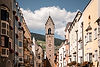
The town of Sterzing
A brief historical overview
Sterzing – Latin Vipitenum – has its origins in a Roman settlement. In the Middle Ages a Bavarian settlement developed here, first documented in 1180. Around 1280 the town received city rights from Count Meinhard II.
After a major fire in 1443, the New Town was rebuilt – from the 46-meter-tall Zwölferturm (Twelve O'Clock Tower) to the lower gate. The New Town is considered one of the most beautiful streets in Tyrol: flanked by arcades and splendid merchant houses from the 15th and 16th centuries, built during the golden age of mining.
Sterzing was awarded the coveted title "I Borghi più belli d'Italia" (The Most Beautiful Small Towns of Italy) – one of the most beautiful small towns in Italy. The Gothic town hall, the medieval arcaded street, and the surrounding mountain panoramas make Sterzing an unforgettable destination.
Sterzing's sights:
-
Parish Church "Our Lady in the Moos"
-
The Zwölferturm: the unmistakable landmark of the town is a 46-meter-tall granite clock tower from the 15th century. It separates the old town from the new town and offers a magnificent view on special occasions.
-
The Sterzing arcades (Old Town & New Town): a beautiful pedestrian zone with colorful bay-windowed houses, elegant façades, and shaded archways, inviting visitors to shop and linger.
-
Sterzing Town Hall: a late-Gothic showpiece building with a notable inner courtyard. Inside is the magnificent Gothic council chamber as well as historic Roman finds.
-
Multscher Museum & Town Museum: housed in the former Teutonic Order house, it displays, among other things, the famous late-Gothic altar wings by the Ulm master Hans Multscher from 1456.
-
Church of the Holy Spirit: a Gothic hospital church directly on the town square, decorated inside with impressive, well-preserved frescoes by the master Hans von Bruneck.
-
Rosskopf (Monte Cavallo): Sterzing's local mountain is reachable by cable car directly from the town center. In summer, panoramic hiking trails and the Panorama Mountain Coaster attract visitors; in winter, Italy's longest illuminated and snow-covered toboggan run.
-
Gilfenklamm (Cascate di Stanghe): a spectacular natural monument in nearby Ratschings/Racines. It is the only gorge in the world cut deep into pure white marble. It can be explored via safe wooden walkways and bridges.
-
Reifenstein Castle (Castel Tasso): one of the best-preserved medieval castle complexes in South Tyrol, in neighboring Freienfeld/Campo di Trens. It was never destroyed and can be visited on guided tours (including the ramparts, bathing room, and torture chamber).
-
Wolfsthurn Castle: South Tyrol's only purely Baroque castle is located in Mareit/Mareta. It sits majestically above the valley and today houses the South Tyrolean Provincial Museum of Hunting and Fishing.